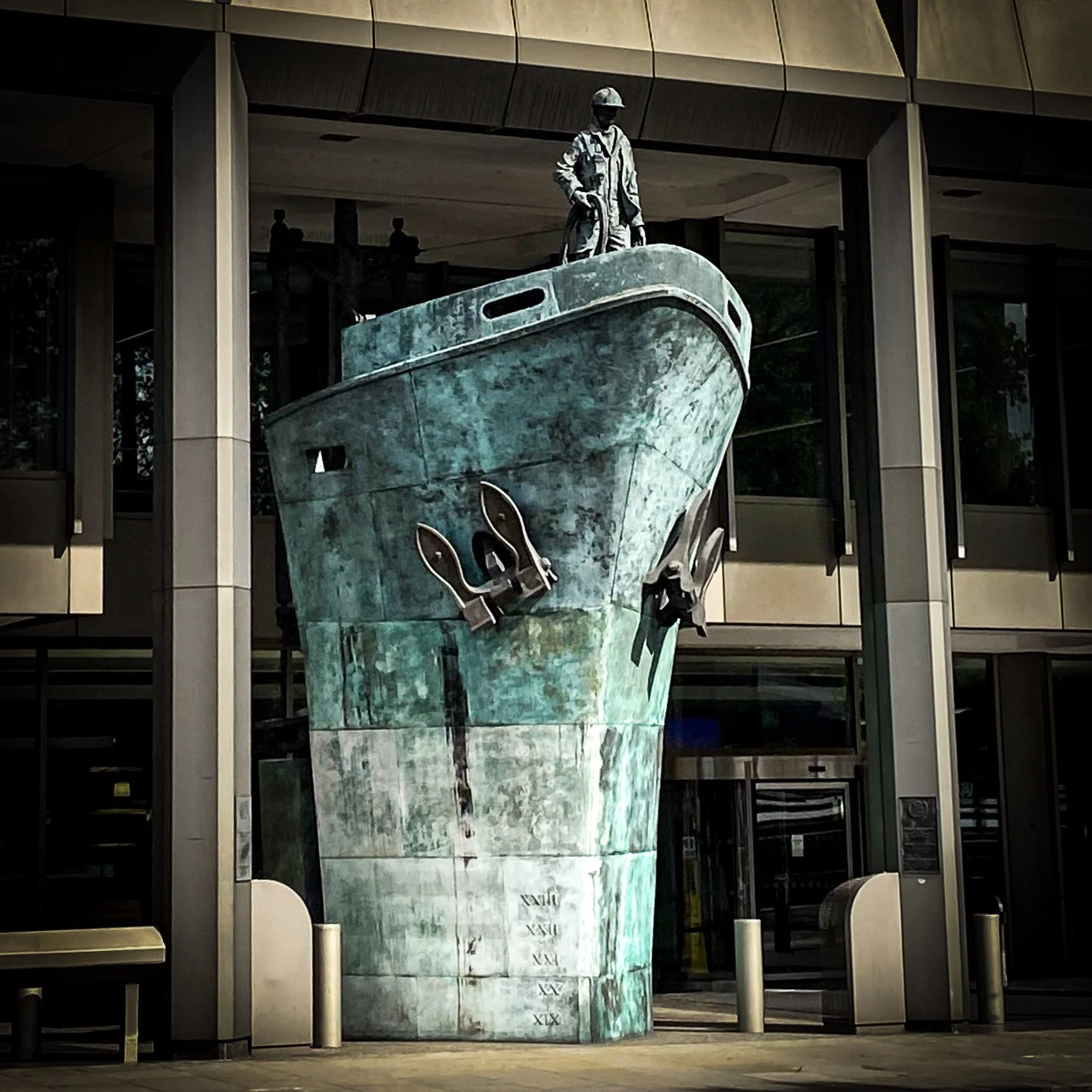
The International Maritime Organization in London / Photo - D. Smith
A Theme of MEPC 85: Global vs. Regional Regulation
Within the maritime world, a clear regulatory pattern is emerging when global frameworks fail to address real-world environmental, market, and geopolitical factors, national and regional authorities fill the gaps. Ahead of the International Maritime Organization (IMO) Marine Environment Protection Committee (MEPC) meeting (MEPC 85) in London, two major fronts illustrate this tension—the stalled IMO Net-Zero Framework (NZF) and the accelerating wave of domestic and regional bans on open-loop exhaust gas scrubber discharges.
Part 1: When Less Is More — Rethinking the IMO Net-Zero Framework
Perhaps it is fair to say that the proposed IMO Net-Zero Framework (NZF) was doomed to stall from the start. It was overly complex, ignored fundamental market realities, relied on a controversial "economic measure" that critics view as a de facto global carbon tax, and clashed with shifting geopolitical priorities.
While land-based carbon emissions are far more ubiquitous and straightforward to mitigate, the IMO charged ahead with a plan that used nearly everything in the regulatory toolbox. It depended on alternative fuels and global bunkering infrastructure at a scale that simply does not exist today. Any workable NZF must be grounded in commercial reality, rational compromise, and flexible compliance options. Above all, it must be simple. That is when less becomes more.
The Regional Elephant in the Room
One major issue that must be addressed is the European Union Emissions Trading System (EU ETS). Once governments establish lucrative revenue streams, they rarely relinquish them. If the IMO adopts a global pricing mechanism, will regional carbon schemes step aside—or will shipowners face overlapping layers of carbon regulation across the globe? Leading shipping associations have already warned against this exact kind of regulatory fragmentation and double-charging.
A Market-Driven Path Forward
Ahead of MEPC 85 (November 30–December 3), U.S. Federal Maritime Commission (FMC) Chairman Laura DiBella outlined four conditions for a viable compromise backed by a growing coalition of IMO member states:
Commercial Realism & Technology Neutrality: Accommodate existing and emerging fuels, explicitly including LNG, bio-LNG, and all biofuels.
Single, Transparent Target: Replace the complex two-tier structure with one clear emissions intensity target, subject to review by 2035 based on actual fuel availability and affordability.
Voluntary, Market-Based Compliance: Eliminate mandatory payments and de facto global carbon taxes in favor of flexible, market-driven compliance.
No Centralized IMO Fund: Reject an IMO-administered fund that collects and redistributes global revenues.
This approach offers a rational blueprint: establish a clear lifecycle (well-to-wake) intensity target and let the market decide how to meet it. Within that framework, the IMO can still apply targeted environmental safeguards—such as addressing methane slip from LNG and washwater discharges from heavy fuel oil paired with open-loop scrubbers—while allowing market forces to incentivize cost-effective solutions.
The Atmosphere Doesn't Care Where Carbon Is Captured or Stored
True technology neutrality should also recognize onboard and shoreside carbon capture and storage (CCS), as well as verified carbon offsets. The atmosphere does not care whether carbon is captured aboard a vessel or at a shoreside facility where the economics and engineering are far more practical—the net climate benefit is identical.
A clear compliance target paired with fuel-neutral, technology-neutral, market-based flexibility, and sensible environmental guardrails is entirely achievable. A centralized IMO tax-and-redistribution fund, however, may rightfully be dead in the water.
Part 2: The Onslaught of Domestic and Regional Bans on Open-Loop Scrubber Discharges
While the IMO debates global carbon rules, coastal states are actively dismantling another IMO-approved compliance strategy: the pairing of Heavy Fuel Oil (HFO) with open-loop Exhaust Gas Cleaning Systems (scrubbers).
In the early part of the last century, ships transitioned from coal to HFO. HFO is essentially the residual sludge left at the bottom of the refinery distillation tower. While HFO is inexpensive, it contains far higher levels of sulfur, heavy metals, and toxic impurities than cleaner fuels like Marine Gas Oil (MGO) or Liquefied Natural Gas (LNG). To comply with IMO global sulfur caps without paying for cleaner fuel, many vessels installed open-loop scrubbers, which spray massive volumes of seawater into the ship’s exhaust funnel to strip out sulfur dioxide (SO₂) and then discharge the acidic washwater directly into the ocean. Scrubber discharges can also contain carcinogenic polycyclic aromatic hydrocarbons (PAHs) and heavy metals including lead, mercury, nickel, and vanadium.
Furthermore, a February 2026 summary report from Lloyd’s Register (PPR 13) noted that studies show scrubber-equipped ships burning high-sulfur HFO actually emit higher particulate matter, black carbon, and CO₂ than vessels burning compliant low-sulfur fuels like MGO. Just as coal-fired propulsion disappeared a century ago, HFO paired with open-loop scrubbers is rapidly heading into the history books.
Domestic and Regional Bans
Without a global scrubber discharge ban from the IMO, domestic and regional efforts to restrict HFO/scrubber discharges accelerated sharply in 2025 and 2026, creating a growing patchwork of coastal mandates across major shipping and cruise corridors:
OSPAR Regional Ban: Under OSPAR Decision 2025/01, 15 North-East Atlantic nations and the EU agreed to ban open-loop scrubber discharges in ports and internal waters by July 1, 2027, expanding to all scrubber systems (including closed-loop) by July 1, 2029.
Greenland: In November 2026, Greenland’s Parliament unanimously approved a phased ban matching the July 1, 2027 (open-loop) and July 1, 2029 (all scrubbers) deadlines—and went even further than OSPAR by extending the ban across its territorial waters.
North America: In the U.S., Alaska lawmakers introduced Senate Bill 253 in 2026 to restrict HFO and prohibit scrubber washwater discharges unless retained for onshore disposal, while port cities like Portland, Maine voted this month to ban cruise ship scrubber discharges in local waters.
Sovereign Authority vs. Voluntary IMO Guidelines
Scrubber advocates have pushed back hard—most recently criticizing Greenland’s ban—by arguing that coastal states must first publish location-specific risk assessments under the IMO’s 2022 Guidelines (MEPC.1/Circ.899) before restricting discharges.
That argument is problematic:
Voluntary Guidance Is Not Binding Law: MEPC.1/Circ.899 is strictly a voluntary guideline, not a binding legal prerequisite, unless a nation chooses to make it a requirement by incorporating it into domestic law.
Sovereign Authority: Under the UN Convention on the Law of the Sea (UNCLOS), coastal states hold sovereign authority over their internal and territorial waters, reinforced by an affirmative duty under Article 195 not to transfer air pollution into marine pollution. MARPOL Annex VI governs air emissions; it grants no right to discharge scrubber washwater into a coastal state’s sovereign waters.
The Precautionary Principle: Demanding conclusive local proof of harm before a state can regulate reverses the internationally recognized Precautionary Principle—explicitly referenced in MEPC.1/Circ.899—which places the burden of proof on the polluter rather than the sovereign state.
Moreover, compelling Arctic-specific science already supports precautionary action:
The 10th Copernicus Ocean State Report (published September 2026) confirms that global oceans have become roughly 17% more acidic since 1985.
Peer-reviewed research demonstrates that glacial meltwater around Greenland reduces the natural buffering capacity of coastal waters that open-loop scrubbers rely on to neutralize acidic discharge.
Cold Arctic temperatures significantly slow the natural breakdown of PAHs, prolonging marine toxicity.
The Bottom Line for Maritime Operators
The European Union Emissions Trading System (EU ETS) and the Greenland scrubber discharge ban both illustrate what the maritime sector will continue to see in the absence of practical IMO requirements in a world where regional and domestic authorities can and will exercise their sovereign power to address the gaps.