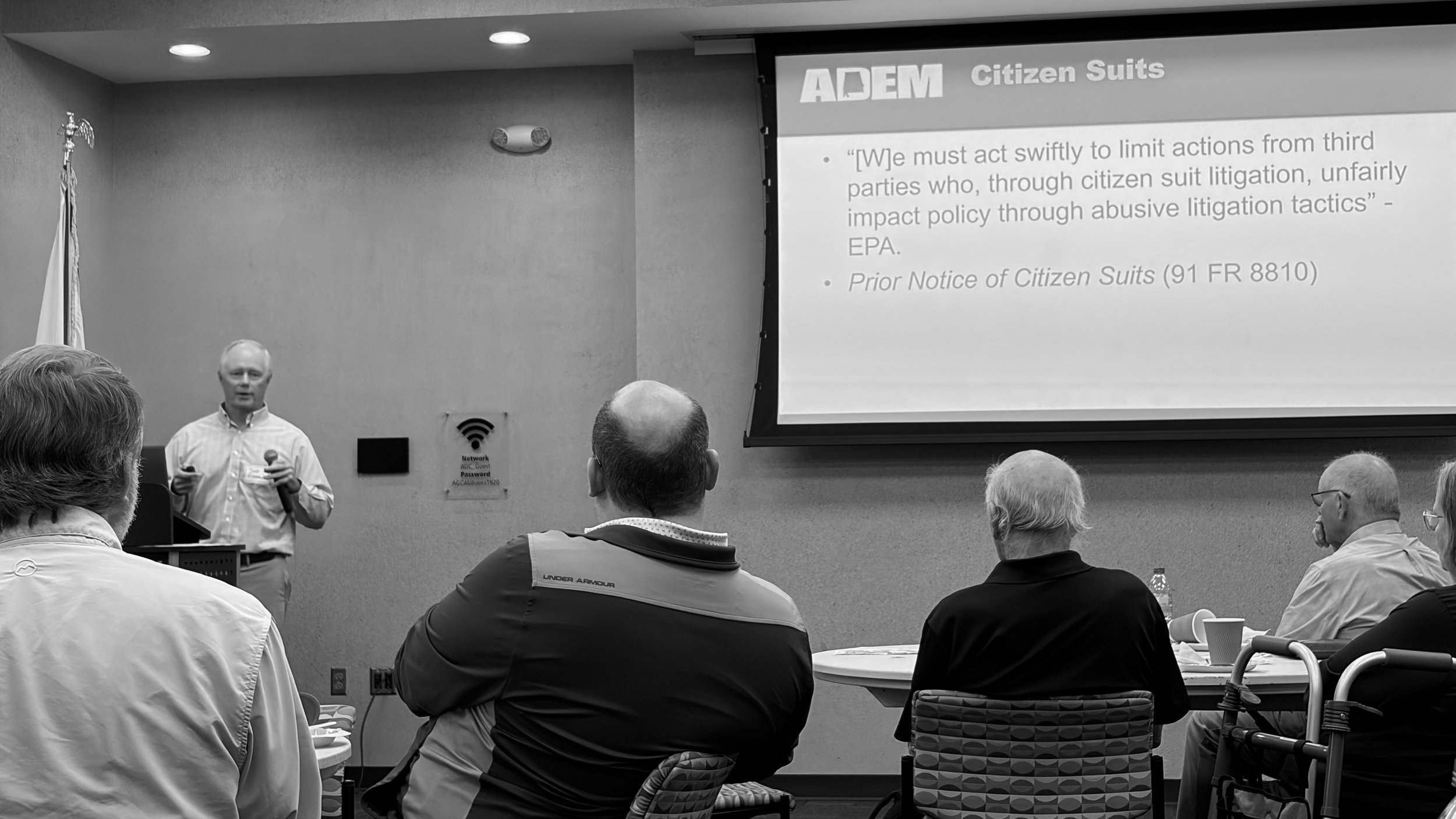
Birmingham Environmental Professionals Association (BEPA) Breakfast 6 Nov 2026. Photo - Danny smith
This PRIMARIUM Regulatory Horizon Update primarily focuses on the enforcement of federal environmental statutes via Citizen Suits. The Clean Water Act (Vessel General Permit and VIDA compliance), the Clean Air Act, and RCRA (hazardous waste management) fall under that umbrella.
On Friday I attended an insightful regulatory update from my old friend, Jeff Kitchens, who is now the Deputy Director of the Alabama Department of Environmental Management (ADEM). Jeff covered a wide range of current issues including Coal Combustion Residuals, the state’s CWA 303(d) list of Impaired Waters, new Construction Stormwater permitting fees, and PFAS. Jeff started his presentation by pointing out that ADEM staffing is currently below the number needed for effective agency performance. Given that Governor-elect Tuberville has proclaimed that he wants to copy DOGE in Alabama and shrink state government agencies, Jeff was not prepared to address any questions related to how the Tuberville administration might affect ADEM staffing.
This PRIMARIUM update expounds on three environmental Citizen Suit developments mentioned by Jeff and offers some potential takeaways related to Citizen Suit enforcement of the current Vessel General Permit and the forthcoming Vessel Incidental Discharge Act (VIDA) regulatory program.
DOJ motion to intervene in NAACP v. x.AI that argues the government has the right to dismiss a Citizen Suit based on Article II powers vested in the Executive Branch
91 Fed. Reg. 8810 Prior Notice of Citizen Suits
EPA’s Compliance First Policy: “[W]e must act swiftly to limit actions from third parties who, through citizen suit litigation, unfairly impact policy through abusive litigation tactics”
91 Fed. Reg. 8810 furthers the EPA Compliance First policy objective of curbing citizen suits because a citizen suit Notice of Intent to sue sent via certified mail can take days or weeks to reach the correct agency personnel, eating into the mandatory waiting period. By requiring instantaneous electronic delivery, the EPA maximizes its reaction window. This gives the agency more time to evaluate the claim and potentially intervene or fix the issue before a Citizen Suit can be filed.
Under federal environmental statutes, a citizen suit is generally barred if the government is already actively pursuing a "diligent prosecution" administrative or civil enforcement action regarding the same violation(s). Receiving NOIs instantly allows EPA to rapidly align field offices, check ongoing enforcement tracks, and initiate government-led compliance actions that can block NGOs from executing high-leverage lawsuits.
The Department of Justice's (DOJ) motion to intervene and dismiss the case in NAACP v. x.AI Corp. also aligns with the strategic objectives of the EPA's "Compliance First" policy. In the lawsuit, the NAACP alleged that Elon Musk's xAI unlawfully installed and operated natural gas turbines to power its Colossus data center in Mississippi without necessary Clean Air Act permits. The DOJ intervened not to prosecute xAI, but to seek dismissal of the citizen suit entirely, based on two primary arguments:
The Statutory Argument: The Clean Air Act does not authorize private citizen enforcement actions when federal and state regulators have evaluated the issue and deliberately chosen to forgo enforcement.
The Constitutional (Article II) Argument: Under Article II of the U.S. Constitution, the executive branch holds exclusive enforcement primacy. The government argued that citizen suits unconstitutionally strip the Executive of its prosecutorial discretion, particularly when a suit threatens broader executive priorities—in this case, national security and defense projects relying on xAI's infrastructure.
In October 2026, District Court Judge Debra Brown denied the DOJ's request to dismiss the suit, ruling that the text of the Clean Air Act gives the government no unilateral authority to wipe out a private citizen suit once it has been legally filed.
VIDA and VGP Implications
The Vessel Incidental Discharge Act (VIDA) does not abolish Citizen Suits for vessel compliance. VIDA amended the CWA by adding Section 312(p)) and the CWA Citizen Suit provision (33 U.S.C. § 1365) still applies.
Once the EPA's National Standards of Performance and the U.S. Coast Guard's implementing regulations take full effect, citizens retain the right to file federal lawsuits against vessel operators for:
Direct violations of the established national effluent standards of performance.
Failure to comply with specific management, operating, or equipment rules set by the Coast Guard.
Nonetheless, VIDA will eliminate Clean Water Act Section 401 state water quality certification requirements from the compliance mix.
Looking ahead, if a Democrat is elected President in two years, we will probably see a fundamental shift in executive enforcement philosophy, with the EPA far less likely to strategically squash citizen suits. Under a Democratic administration, the restrictive components of the "Compliance First" policy would likely be rescinded, though parts of the underlying structural changes—like the digital infrastructure of 91 Fed. Reg. 8810—would likely remain in place for entirely different strategic purposes.