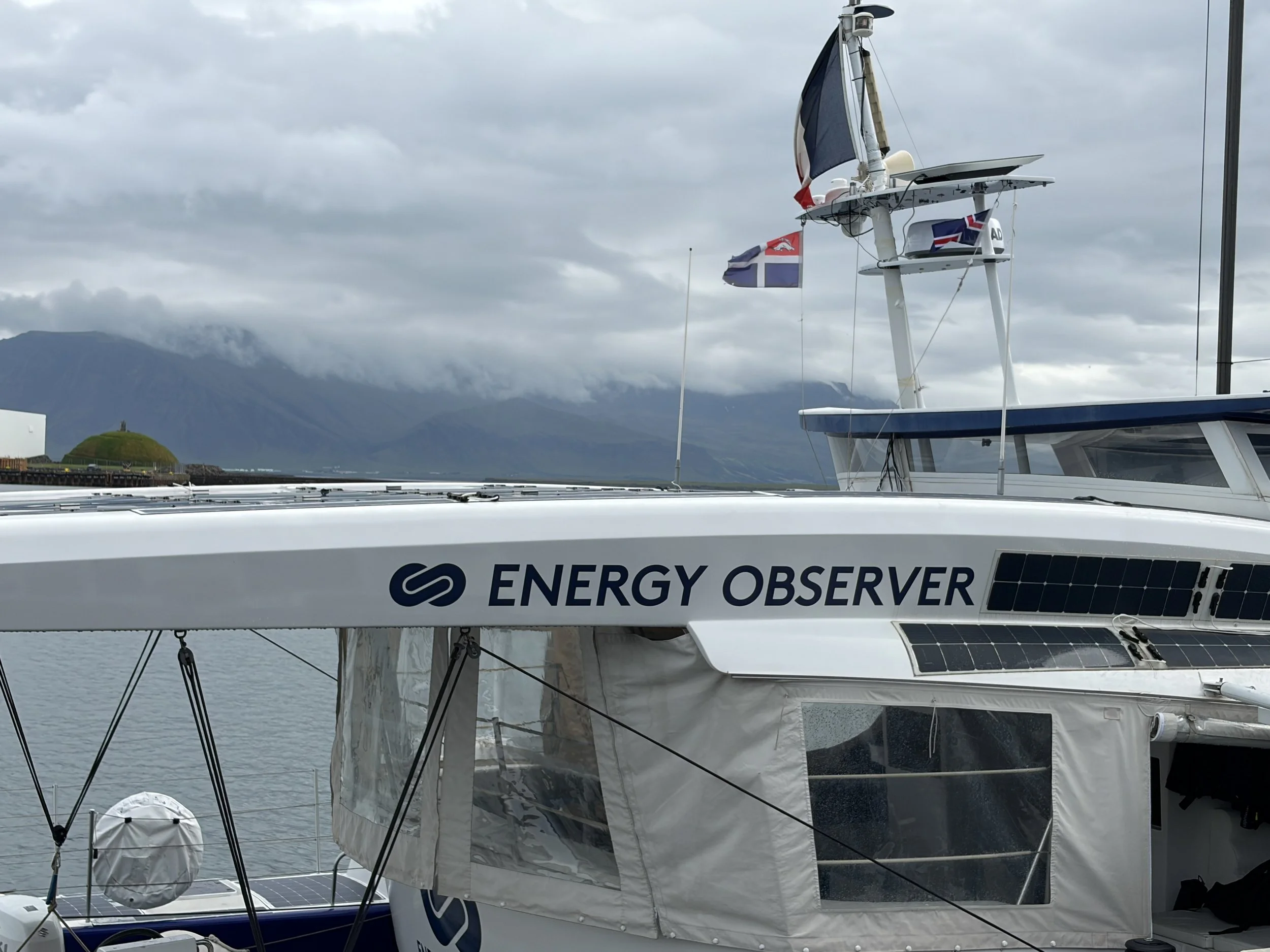
Onboard the Energy Observer 1: A Blueprint for Sustainable Cruising
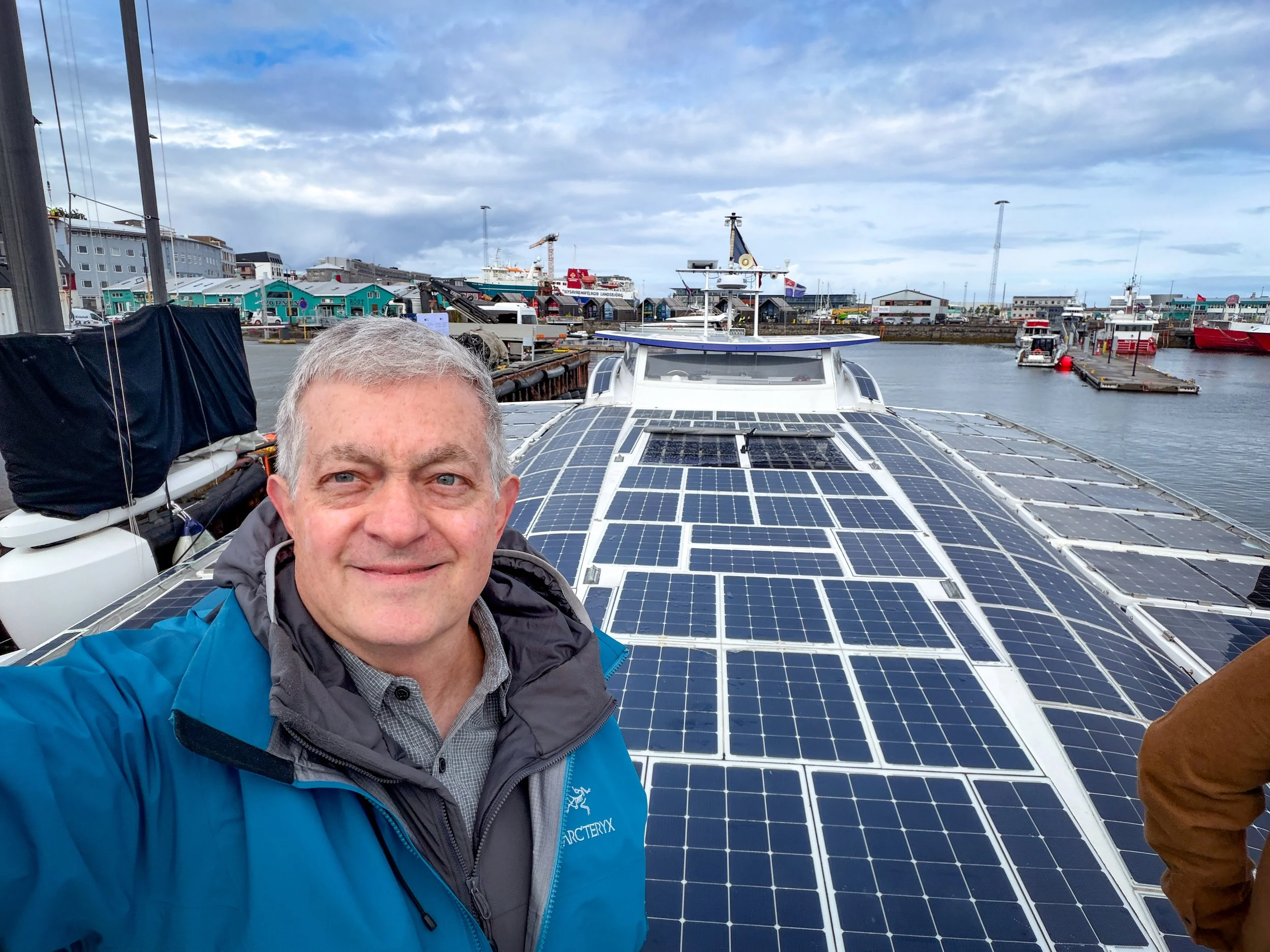
I was invited to tour the Energy Observer 1 (EO1) in the port of Reykjavík today. Stepping onto this revolutionary vessel offers a fascinating look at the future of maritime travel. In an increasingly carbon-constrained world, this pioneering ship serves as a tangible, living blueprint for how the commercial cruise industry can transition toward truly sustainable cruising.
A Racing Legend Reborn as a Green Laboratory
The ship we visited is the EO1, but it has a surprisingly rich history that predates its green energy mission. Long before it became a floating smart-grid, this very vessel was a high-performance racing catamaran originally built in the 1980s.
Today, it has been completely reimagined into a zero-emission laboratory. It currently operates with a tight, efficient crew capacity of 15 people. Because EO1 is an aging vessel, it will eventually need to be replaced, but it continues to serve as the ultimate testing ground for experimental maritime tech.
How the Ship Operates: A Smart Energy Loop
The engineering onboard is a masterclass in clean energy integration, driven by a highly advanced, real-time energy management system that balances several power sources seamlessly:
Solar Power: The deck is covered in several distinct types of solar panels, each testing different photovoltaic technologies to maximize electricity generation in changing weather.
Hydrogen Generation & Storage: The electricity generated by the solar panels serves two vital functions. First, it powers a reverse osmosis system to create pure water from the sea. Second, it powers an onboard electrolyzer that uses that pure water to generate clean hydrogen gas via electrolysis.
Fuel Cells & Water Recycling: When solar power is low, the stored hydrogen is fed into fuel cells to produce steady electricity. A brilliant sustainability feature of this system is that the water discharged as a byproduct from the fuel cell is completely captured and reused onboard.
Propulsion and Hydrogeneration: The ship uses massive wings-sails for wind-driven propulsion. In a clever engineering twist, when the ship is moving quickly under sail power, its dual underwater turbines (one mounted on each hull) reverse their rotation. Instead of consuming power to push the boat, the passing water turns the turbines backward, transforming them into hydrogenerators that produce electricity to recharge the batteries.
The Future of the Fleet: EO2 and EO3
The lessons learned from EO1 are already driving the next generations of zero-emission commercial shipping, which will scale up significantly:
Energy Observer 2 (EO2): This upcoming vessel will be a dedicated commercial cargo ship powered completely by liquid hydrogen (LH2).
Energy Observer 3 (EO3): Designed as a larger exploration vessel, EO3 will expand the crew capacity to 40 people. It will be powered by liquid ammonia, targeting operations predominantly in Asia where the necessary ammonia bunkering infrastructure is already rapidly developing.
Real-World Application: The Norwegian Heritage Fjords
The decentralized, zero-emission technologies proven by the EO1 are not just futuristic concepts—they are urgent solutions for the maritime industry. A prime example of where this technology is needed right now is the Norwegian Heritage Fjords.
With strict environmental regulations mandating that ships operating in these pristine, UNESCO-protected waters must be entirely zero-emission, commercial cruise lines can look directly to EO1's hybrid hydrogen, solar, and wind-assisted systems to build their own compliance strategies and protect the world's most vulnerable marine ecosystems.
Congratulations to French based Energy Observer and merci beaucoup for the incredible tour today!