Global Ship Biofouling Regulation & Compliance Outlook

The International Maritime Organization (IMO) London / Photo - D. Smith
Executive Summary
Biofouling is no longer viewed solely as a fuel-efficiency issue; it is now a primary focus of global maritime biosecurity to prevent the spread of invasive species, reduce fuel consumption, and reduce greenhouse gas emissions. With slow International Maritime Organization (IMO) action on mandatory biofouling requirements, nations around the world are increasingly adopting stringent domestic requirements aligned with or exceeding the IMO 2023 Biofouling Guidelines.
The potential cost of a cruise ship being denied port entry due to biofouling could be significant - millions of dollars. The cost could include high-seas cleaning expenses, significant passenger compensation, flight and hotel logistics associated with disembarking passenger delays, lost revenue, and reputational damage.
Ship biofouling may also present an Endangered Species Act (ESA) compliance risk in US ports because invasive species can directly threaten protected native wildlife and their critical habitats. The introduction of non-native species via ship hulls is considered a major cause of global species extinctions. These invasive "hitchhikers" can outcompete, prey upon, or spread diseases to ESA-listed species.
Research by the University of Cambridge and the British Antarctic Survey addresses potential adverse effects from biofouling in Antarctica related to the introduction of non-native species from ships. Their research advocates for measures to safeguard Antarctic ecosystems from ship biofouling threats. Biofouling risks from cruise and expedition ships should be addressed as a potential adverse environmental impact within their required Initial Environmental Evaluation (IEE) to comply with the Antarctic Treaty and the US Antarctic Science, Tourism, and Conservation Act of 1996.
Careful itinerary planning, voyage planning, ship hull & niche area cleaning before macrofouling forms, and compliance monitoring are essential risk management strategies.
The Current Global Biofouling Standard: IMO 2023 Biofouling Guidelines
The IMO’s current framework emphasizes a risk-based approach over fixed cleaning schedules.
Fouling Rating 1: Defined as "microfouling" (slime only). This is the target operational state.
Trigger Points: Inspections are recommended every 12–18 months, but risk factors could warrant an inspection frequency of every 6 months. Reaching a Rating 2 (small amounts of macrofouling) typically triggers a requirement for reactive cleaning.
Proactive vs. Reactive: The guidelines encourage frequent "proactive cleaning" of slime to prevent the attachment of larger organisms.
Regional & National Mandates
Several jurisdictions have implemented requirements that exceed international guidelines:
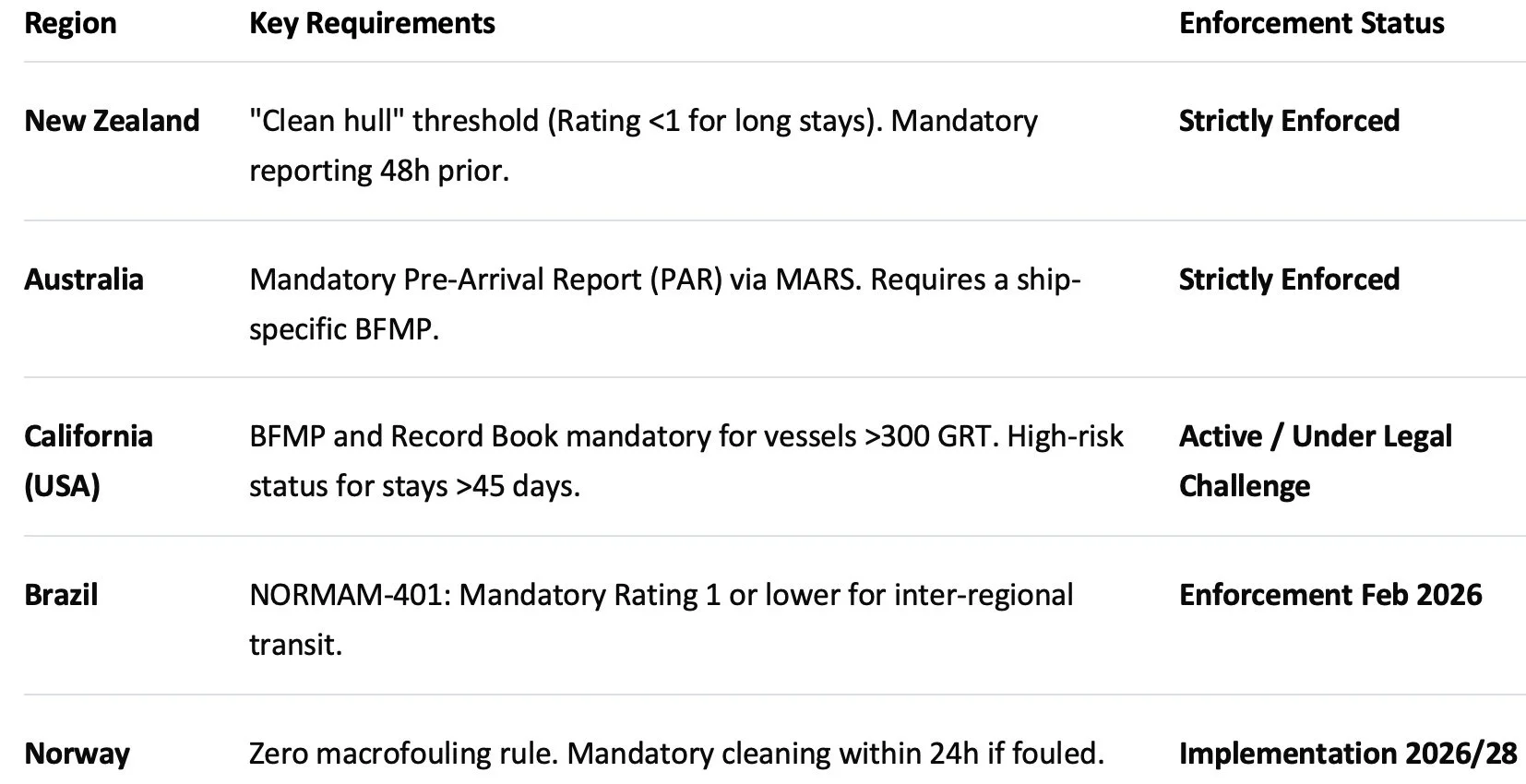
US Biofouling Regulatory Environment & Legal Conflict
The U.S. is currently in a transition period under the Vessel Incidental Discharge Act (VIDA).
The Lawsuit: The California State Lands Commission is currently suing the EPA (Feb 2025) to prevent federal preemption from weakening California's stricter state standards.
Current Rules: Until 2026, the 2013 VGP remains the standard, requiring ships to minimize discharge and use capture technology for in-water cleaning "when available and feasible."
Technical Compliance: In-Water Cleaning
Capture Technology: There is a global shift toward requiring the capture of removed fouling (down to 50μm) for any cleaning involving macrofouling to prevent the release of biocides and invasive larvae.
Niche Areas: Regulations now explicitly target "niche areas" (sea chests, bow thrusters, rudders) as these are high-risk zones for harboring invasive species.
New International Standards Organization (ISO) Biofouling Standards
ISO 20679:2025 Ships and marine technology — Marine environment protection — Testing of ship biofouling in-water cleaning systems. This document provides detailed and rigorous procedures for the independent performance testing of all forms of ship in-water cleaning (IWC), including on all types of biofouling (i.e. biofilms/microfouling and macrofouling), all external submerged surfaces (i.e. hull and niche areas), and both proactive and reactive IWC systems with or without the capture, processing, and disposal of debris. This document also includes testing protocols and describes how to produce data and report on the efficacy and safety of IWC systems to clean various ship surfaces and for the capture and disposal of cleaning debris.
The development of specific IWC performance requirements, criteria, or standards is outside the scope of this document and is the responsibility of individual authorities, agencies, or administrations. Similarly, while some methods and approaches described in this document can apply to other ship biofouling management approaches, systems designed to kill or prevent biofouling on external surfaces without removal (i.e. without in-water cleaning), and systems that remove or treat biofouling on internal surfaces (e.g. seawater pipes) or external surfaces of intricate mechanical components (e.g. external parts of propeller shaft seal), are also outside the scope of this document.
ISO 6319:2026 Ships and marine technology — Marine environment protection — Conducting and documenting in-water cleaning of biofouling on ships. This document provides requirements and best practices for planning, conducting and documenting in-water cleaning (IWC) operations safely, efficiently and in an environmentally sound manner. Additionally, this document provides requirements and best practices for reporting on the effectiveness of IWC operations.
This document addresses all forms of IWC of external submerged surfaces, which are hull and niche areas, all types and levels of biofouling, which means biofilms, microfouling and macrofouling, conducted both with or without capture. It does not address internal piping.
The document has been established to inform ports, regulatory agencies, ship biofouling IWC service providers, inspection service providers, IWC equipment manufacturers, coating manufacturers, shipowners, ship managers, ship operators and other relevant stakeholders.
Future Outlook (MEPC 84 & Beyond)
The IMO is moving toward a mandatory "Biofouling Convention."
PPR 13: The 13th session of the IMO's Sub-Committee on Pollution Prevention and Response (PPR 13) took place 9-13 February 2026 at the International Maritime Organization (IMO) in London. PPR 13 recommended that a new legally binding framework for the control and management of ships’ biofouling be developed to minimize the transfer of invasive aquatic species.
MEPC 84 (April 27 – May 1, 2026): IMO’s Marine Environment Protection Committee (MEPC) is expected to formally accept the PPR 13 recommendation.
Target: A final draft of the mandatory framework is expected by 2029, with global implementation in the early 2030s. In the meantime, it may be challenging to navigate the proliferation of domestic biofouling requirements that are mostly aligned with 2023 IMO Biofouling Guidelines.